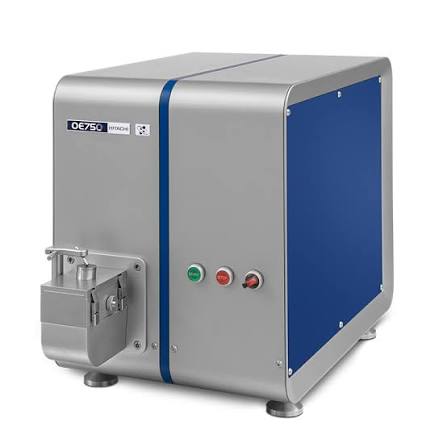
Last year we welcomed a new team member here at Pb Alloy Resources, and she has quickly become the hardest working member of the shop. She does not take lunch breaks. She doesn’t mind a long day. And she can tell you the exact elemental composition of a lead alloy sample faster than anyone here can pour a cup of coffee.
Her name is ZOE.
Technically, she is a Hitachi OE750 optical emission spectrometer, one of the most capable OES analyzers you can put in a metals lab. But the day she arrived in 2025, somebody (me) slapped a Z in front of the OE750 badge on the faceplate, and that was that. ZOE750. ZOE for short. The name stuck before the packing foam hit the recycling bin.
What ZOE Actually Does All Day
ZOE’s job is elemental analysis, which is the heart of everything we wrote about in our post on why testing and certification matter when you buy lead. Every lead alloy we sell, whether it is pure lead ingots, antimonial lead, tin lead solder alloy, or a custom bullet casting alloy, is defined by its composition. Antimony percentage, tin percentage, trace elements like arsenic, copper, bismuth, and silver. ZOE is how we verify all of it.
Here is her routine. We hand her a prepared sample from a batch. She generates a small electrical spark on the surface, which excites the atoms in the metal and makes them emit light. Every element emits at its own signature wavelengths, kind of like a fingerprint made of light. ZOE reads those wavelengths, measures their intensities, and reports back exactly what is in the sample and in what percentage, often down to fractions of a percent. The whole spark-to-readout process takes well under a minute.
She never guesses. She never rounds up to be polite. If a batch of Pb-Sb-Sn alloy is supposed to run 4 percent antimony and 2 percent tin and it came out at 3.6 and 1.8, ZOE says so, and we adjust the melt before anything gets poured into ingots. That is what routine OES testing looks like when it is built into production rather than bolted on as an afterthought.
Why We Bought a Serious Instrument Instead of a Basic One
There are plenty of ways to get a rough idea of what is in a piece of lead. There are far fewer ways to get a verified, repeatable, documentation-grade answer. The OE750 sits in the latter category, and that mattered to us for a few reasons.
First, detection limits. ZOE can see trace elements at very low concentrations, which is exactly what you need when a customer’s application is sensitive to contamination. Radiation shielding work wants verified high-purity lead. Battery manufacturing cares about specific trace elements. Bullet casters want a tin and antimony ratio they can trust so hardness comes out consistent, batch after batch, at the BHN target they loaded for.
Second, element coverage. ZOE reads a very wide range of elements, so we are not blind to the odd contaminant that a narrower instrument would miss. When you buy scrap lead like we do, and turn it into clean, certified secondary lead alloys, that breadth is not a luxury. Mixed scrap streams like wheel weights, range scrap, and battery lead can carry surprises, and ZOE catches them before they reach a customer.
Third, repeatability. A certificate of analysis is only as good as the instrument and process behind it. When we hand you a COA for your specific lot of lead alloy, the numbers on that page came off ZOE, from a documented test on your actual material. Not a generic spec sheet. Not an assumption based on what went into the pot.
What ZOE Means for You as a Buyer
If you are buying lead ingots, lead alloys, or custom Pb-Sb-Sn blends, ZOE is quietly working for you whether you ever meet her or not. She is the reason we can say yes to the questions we told you to ask any lead supplier: Do you run OES analysis? Can you provide a certificate of analysis for my order? Can you formulate and verify a custom alloy to my spec?
Custom work is honestly where she shines brightest. When a customer needs a specific hardness target for bullet casting, a verified purity level for shielding, or a particular alloy composition for casting work, we formulate the melt, ZOE verifies it, and we do not ship until her numbers match your spec. Formulate, test, adjust, confirm. She keeps us honest, and she keeps your material consistent.
And if you are selling us scrap lead, ZOE works for you there too. Accurate composition analysis means accurate grading, which means fair pricing based on what your material actually contains.
Come Say Hi
We are having more fun with ZOE than anyone should probably admit about a piece of laboratory equipment. But behind the nickname is the serious point we keep coming back to on this blog: composition claims without testing behind them are just claims. ZOE is our answer to that, running verified elemental analysis on the lead alloys leaving our shop and the scrap lead coming in.
Need a certificate of analysis, a custom alloy built and confirmed to spec, or just want to know exactly what is in your lead? Reach out and we will put ZOE on it. She is always ready to spark up a conversation.